Paper Versus Digital Journaling: What My Research Found
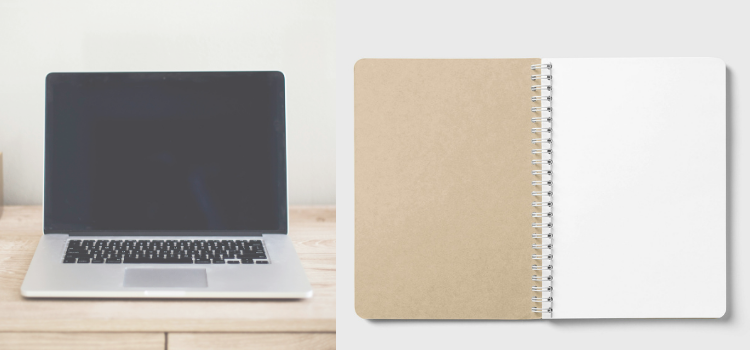
I’ve kept a journal in some form or another since I was a child. As technology has evolved, my journaling has moved from pen and paper to trying different kinds of digital journaling tools. While I’ve flip-flopped between analogue and digital the last 10 years, I’ve wondered: what difference does the format or medium make to how I journal? (I wrote a post about this a few years ago here).
At the same time, digital programmes and interventions related to mental health and wellbeing have increased, especially since the pandemic. Something I found interesting while researching this topic is that, while the efficacy of these interventions has been studied, the effectiveness of digital interventions compared to pen and paper interventions overall has not. And this matters: much of the research done on journaling pertains to pen and paper (what I refer to as “analogue”) journaling. How do we know those same effects translate to digital interventions, or if digital interventions are experienced in the same way?
This was something I wanted to explore as part of my psychology MSc. While the project requirements and limitations of distance learning made it tricky to run a quantitative study comparing the two, I was interested in learning more about people’s experiences of using the two mediums. Again, I couldn’t find any existing research on this, which seems like an important factor when you consider that, in the context of mental health interventions, someone’s experience directly affects their engagement and adherence to a treatment plan.
To that end, I surveyed 16 people who have previously used both analogue and digital journaling about their experience with both. I asked them to contrast the experience and talk about the benefits and challenges of each.
There were lots of interesting findings (and a few surprises!) in their responses. Here are a few things that stood out:
Digital journaling is easier… but maybe too easy?
Digital journaling comes with a level of convenience that analogue journaling doesn’t: technology is ubiquitous, so it’s always there with us. It also has important accessibility benefits for people who struggle with writing by hand. At the same time, it also often relies on mechanisms and technology we might not fully understand or feel confident in. This can lead to worries about people being able to access our journaling, and losing data. It also raises interesting questions about ownership, for example, who really owns entries stored on a server belonging to someone else, and how do we arrange legacy access for when we die.
Typing can outrun your thoughts
While a couple of participants mentioned appreciating the speed of typing, multiple people commented on how it felt too fast. While writing by hand was a slower and more effortful process, this reduced speed gave them time to think more deeply and reflect on what they were writing, something that was perceived as missing when using the more efficient medium of keyboard. This in turn seemed to affect the depth of their journaling, for example one participant noted their digital journaling feeling more like an activity log than thoughtful self-reflection.
While it hasn’t been directly related to journaling in any existing research that I could find, I noticed a parallel between how participants described this aspect of their experience and Daniel Kahneman’s dual process theory outlined in his book, Thinking, Fast and Slow. For some people, typing seemed to feel like fast, automatic thinking, while handwriting was slower and required more deliberate, potentially deeper, thought and effort.
Writing by hand has a certain “je ne sais quoi”
Multiple participants referenced valuing the sensory experience of writing by hand, something which was missing in typing. These descriptions verged on the sentimental or reverent: the feel of the paper, the physical act of making marks on a page, and a real sense of attachment to a physical notebook. This ties in with a growing body of research suggesting the importance of mind-body connection. Like the difference in speed, the act of forming letters while writing by hand seems to lead to a more embodied form of reflection and processing that isn’t quite the same when tapping on a keyboard.
Digital journaling has its own superpower
People who used multimedia in their journaling entries (photos, video, etc.) described it as enriching their experience and helping them re-experience moments in a way that just writing about them didn’t. They also doubled as journaling springboards and memory aids for future entries. As technology develops and becomes more interactive, I think this is an interesting opportunity for future study, especially given the importance of the sensory experience I mentioned above.
As the above suggests, there is no definitive answer to the “paper versus digital” journaling question. Digital journaling has major accessibility benefits for people who find writing by hand to be challenging, and anything that lowers barriers to entry, not only for accessibility but also convenience and engagement, is positive. But the study also highlighted some interesting questions about depth of reflection and how the speed of typing versus writing by hand can affect how we think—and what we think about.
I am exceptionally grateful to everyone who shared the study and participated in it, thank you! If you would like to read the full study (literature review, methodology, analytical process, and all), you can do that here.
Otherwise, I would love to hear your experience: are you team digital or team analogue, and why? Feel free to drop me a line and let me know :)